
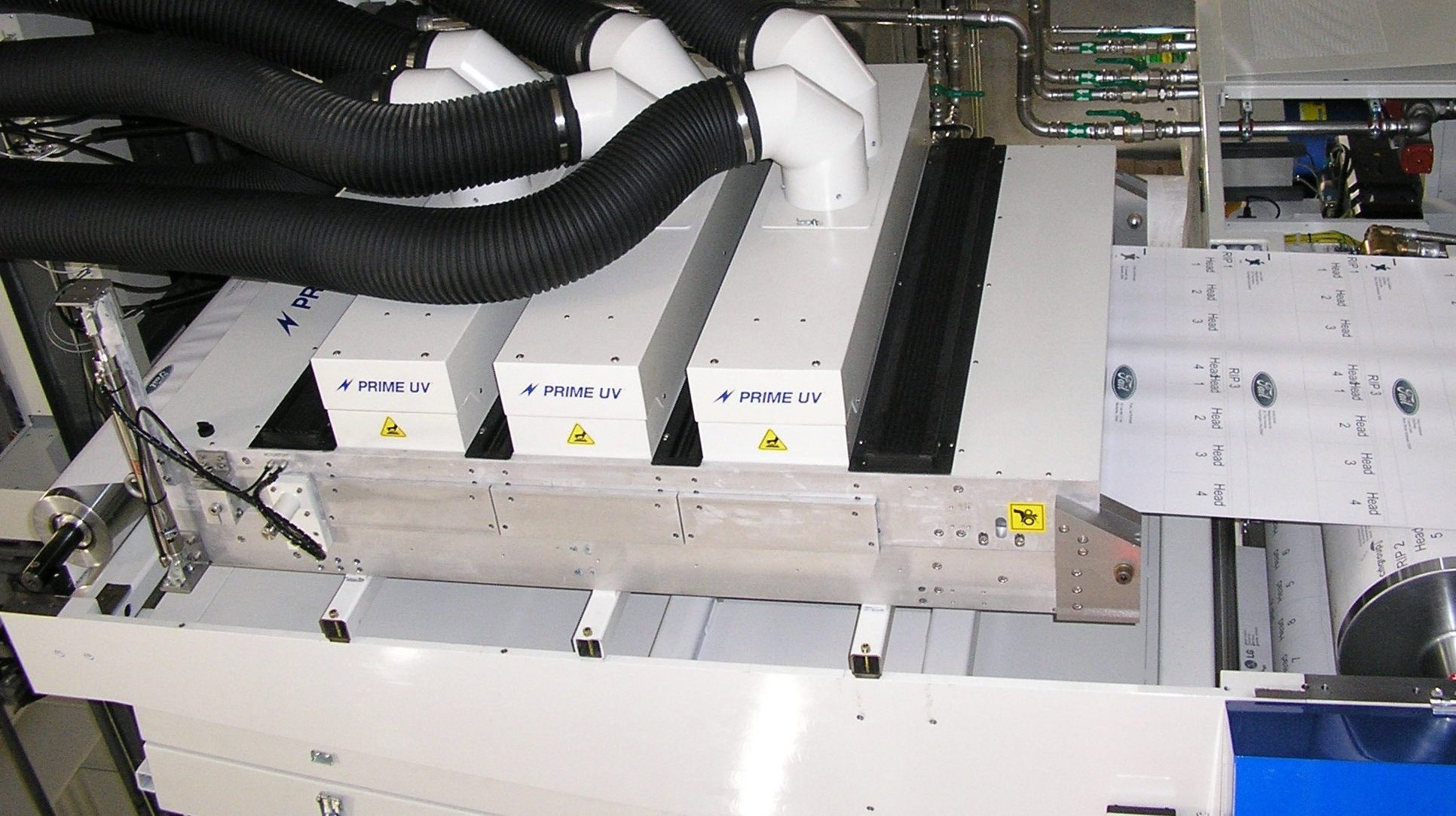

NITRO UV Nitrogen-Inerted UV Curing System
Nitrogen-inerted UV curing engineered to reduce oxygen inhibition and support demanding coating and printing applications.
NITRO UV combines Prime UV-IR curing systems with a nitrogen-inerted curing chamber designed to maintain oxygen levels below 50 ppm. The system can be configured around the UV platform, substrate width, line speed, chamber geometry and production requirements.

Get in Touch with a Product and Application Specialist
Reduce Oxygen Inhibition During UV Curing
Oxygen at the surface of a UV-curable coating can interfere with polymerization and affect cure quality.
NITRO UV creates a nitrogen-rich curing environment that reduces oxygen concentration around the substrate during exposure to UV energy.
Prime specifies oxygen exclusion levels below 50 ppm / 0.005%, with oxygen concentration monitored using an inline continuous analyzer.
For applications where surface cure, coating performance or chemistry efficiency are important, nitrogen inerting gives process engineers another variable they can control rather than relying solely on increased UV output.
Key Outcomes
Maintain oxygen levels below 50 ppm within the curing chamber.
Reduce oxygen inhibition at the coating surface.
Support compatible UV chemistries with lower photoinitiator requirements.
Configure the chamber around flat or roll-based production.
Integrate with multiple Prime UV curing platforms.
Monitor oxygen levels continuously during production.
Support substrate widths up to 2000 mm.
Configure systems for process speeds up to 450 mpm.
Application-Engineered Nitrogen Inerting
Nitrogen inerting should be designed around the complete curing process, not added as an isolated chamber.
Prime evaluates the production equipment, UV chemistry, substrate, web width, line speed, UV source, chamber geometry and oxygen-exclusion requirements before recommending a NITRO UV configuration.
That application review can influence:
UV curing platform
chamber type
nitrogen flow
substrate entry and exit design
oxygen monitoring
web width
process speed
cooling requirements
controls integration
The result is a nitrogen-inerted curing system configured around the actual production environment.
Compatible With Multiple Prime UV Platforms
Add Nitrogen Inerting to the Appropriate UV Platform
NITRO UV can be integrated with multiple Prime UV curing technologies, including:
MINIMAX
OPTIMUM
RADMAX
LEDMAX
UV LED Series
That allows Prime to select the curing source based on the application while designing the inerting chamber around the same production requirements.
Controlled Oxygen Exclusion
Maintain Oxygen Levels Below 50 ppm
NITRO UV is designed to maintain oxygen exclusion levels below 50 ppm / 0.005% inside the curing chamber.
Oxygen levels are verified using an inline continuous oxygen analyzer, giving operators a measurable process parameter rather than relying on assumed chamber conditions.
Nitrogen Chamber Configurations
Flat or Roll-Based Chamber Designs
NITRO UV chambers can be configured for:
flat substrate paths
roll-supported substrates
laboratory systems
full production systems
This flexibility allows the inerting chamber to be adapted to different machine geometries and process-development requirements.
Contact-Free Substrate Entry and Exit
Protect the Web Path Through the Curing Zone
NITRO UV supports contact-free substrate entry and exit through the curing chamber.
For sensitive films, coatings or high-speed webs, avoiding unnecessary substrate contact can simplify integration and reduce the risk of marking or disturbing the material as it enters and exits the inerted zone.
Accessible Chamber Design
Easier Access to the Quartz Barrier Window
The NITRO UV cassette is designed to provide access to the quartz barrier window for inspection and maintenance.
For production equipment expected to remain in service for years, access to components that require cleaning or service is an important part of system design.
Photoinitiator Reduction
Potential to Reduce Photoinitiator Requirements
By reducing oxygen inhibition during cure, nitrogen inerting can allow compatible formulations to operate with lower photoinitiator concentrations.
Prime’s NITRO UV documentation cites photoinitiator reductions from approximately 7–16% to below 2% in applicable curing chemistries.
Potential production and formulation benefits may include:
reduced coating odor
lower photoinitiator-related chemistry cost
reduced migration of raw materials through the substrate
reduced coating yellowing
Actual formulation changes depend on the chemistry and application and should be validated through testing.
Coating and Cure Performance
Cure Conditions That Can Support Coating Performance
Reducing oxygen at the coating surface can influence polymer network formation and final coating properties.
Depending on formulation and process conditions, nitrogen-inerted UV curing can support improvements in:
surface gloss
chemical resistance
hardness
abrasion resistance
cure of challenging pigments or colors
The product sheet specifically identifies higher polymer network density, gloss, chemical resistance, hardness, abrasion resistance and improved curing of difficult colors as curing benefits.
Production Width and Speed
Configure NITRO UV Around the Line
NITRO UV supports:
substrate widths up to 2000 mm
process speeds up to 450 mpm
UV output up to 600 W/in, depending on the selected Prime UV platform and configuration
Actual operating conditions depend on UV chemistry, substrate, chamber configuration, oxygen target and curing-system selection.
Where NITRO UV Fits
Applications
-
Nitrogen-inerted UV curing for compatible flexographic applications where oxygen inhibition, coating chemistry or surface properties are important process variables.
-
Can be integrated into compatible offset applications requiring a controlled low-oxygen curing environment.
-
Applicable to digital UV processes where inerting may improve cure behavior for compatible inks or coatings.
-
NITRO UV can be evaluated for packaging applications where cure performance, migration considerations and formulation requirements are important.
-
Nitrogen inerting can support compatible label-printing and coating processes requiring controlled surface cure.
-
Applicable to industrial coating processes including furniture films, floor laminates, facade elements and other continuous-production materials.
-
NITRO UV can also be configured for compatible release-liner coating processes where low-oxygen curing conditions are required.
Technical Specifications
| Design Parameter | HAK3 |
|---|---|
| UV Platforms | MINIMAX, OPTIMUM, RADMAX, LEDMAX, UV LED Series |
| Cooling | Water and air, depending on UV platform |
| Maximum Power | Up to 600 W/in |
| Maximum Substrate Width | 2000 mm |
| Maximum Process Speed | Up to 450 mpm |
| Oxygen Exclusion | <50 ppm / 0.005% |
| Inert Gas | Nitrogen |
| Chamber Types | Flat or roll; lab or production |
| Contact-Free Entry / Exit | Yes |
| Oxygen Monitoring | Inline continuous analyzer |
| Cassette Access | Access to quartz barrier window |
Support Beyond Installation
Support for the Life of the System
Prime’s involvement continues after the NITRO UV system enters production.
Customers have access to technical support, remote diagnostics where supported by the underlying UV platform, OEM replacement components and controls expertise throughout the life of the curing equipment.
As production requirements, controls or curing chemistry change, Prime can also assist with system evaluation, component replacement and upgrade planning.
Talk Through Your Application
Could Nitrogen Inerting Improve Your UV Curing Process?
UV chemistry, oxygen sensitivity, substrate, line speed, web width and curing technology all influence whether nitrogen inerting is appropriate.
Talk with a Prime application specialist about the process and determine whether NITRO UV — and which Prime UV platform — is the appropriate configuration.
Related Products
RADMAX UV Series
For wide-web and high-speed arc-lamp applications that may benefit from nitrogen inerting.
OPTIMUM UV Series
For configurable web and industrial UV arc-lamp applications.
LEDMAX UV LED Systems
For applications evaluating nitrogen-inerted LED curing rather than traditional arc-lamp curing.